State Police Must Be Earned, Not Handed Over

The constitutional fight is won on State Police in Nigeria. The real one is over a law nobody has written yet, which is, the rules a state must meet before its police can carry arms. Nigeria has already tried two ways of handing power to the states. Only one of them worked. In this piece, I argue that if a state must have its own Police, it must accept an independent commission responsible for oversight and certification, and be accountable for monies meant for it state policing.

On 30 September 2025, gunfire in Akinlalu, a farming town in Ife North, left residents dead. The police said their investigation pointed to Osun’s own Amotekun corps. A team from Force Headquarters in Abuja then arrested about 25 operatives and sealed the corps’ offices. One of the town’s chiefs, the Aro of Akinlalu, lost two of his children. Months later, Governor Ademola Adeleke was complaining of fresh kidnappings and of operatives held without trial, and civil society groups were still asking for the offices to reopen in December.

Akinlalu is the state police debate in one town. A state force was accused of killing the people it guards. A federal force answered by shutting the whole outfit down. Nobody in between could weigh the evidence and fix the problem without taking sides.

That missing referee is now the most important thing in Nigerian security policy. All 36 state assemblies have approved the constitutional amendment, and President Tinubu received the bill on 18 November. But the amendment does not switch anything on. Under the version the Senate passed, no state police service may begin operations until it is certified as meeting “national minimum standards”, set by an Act of the National Assembly. The Senate itself has asked the President to send a National Policing Bill to supply that framework. Whoever writes those standards decides what state police becomes. Nigeria’s own recent experiments in electricity and council funding show how to write them.

What the local government taught us

On 11 July 2024, the Supreme Court ruled that council allocations must go to elected councils, not to state governments. It was a clean legal victory. Yet Daily Trust found that 11 months later more than ₦3.4 trillion meant for councils had still passed through state-controlled joint accounts, and New Telegraph reported that governors kept their hold on council money into 2026.

The deeper problem is who runs council elections. Governors appoint the state electoral commissions, and the results look the same whatever the party. In Kaduna, the APC won all 23 chairmanships and all 255 councillor seats. In Anambra, APGA won every seat in all 21 councils. In Taraba, the PDP won every seat, unopposed. This is not one party’s vice. It is what happens when power is handed over in law while the appointments that control it stay with one office.

What electricity taught us

The Electricity Act 2023 took a different route. States won the right to regulate their own power markets, but the federal regulator, NERC, transfers oversight only to states that meet set conditions and build a working regulator. Fifteen states have now made that transition, starting with Enugu, Ekiti and Ondo in October 2024. Meanwhile NERC keeps regulating the states that are not yet ready, along with everything that crosses state lines.

It is too early to say whether state regulators will give Nigerians steadier light, and this essay does not claim they will. The point is the method. Power moved to states that proved they could use it, at their own pace, and nobody was left without a regulator in the meantime.

What the standards should test

The danger is that “minimum standards” becomes a checklist of uniforms, vehicles and recruits. Those matter, but Akinlalu was not a shortage of rifles. It was a shortage of independence. The Policing Bill should make certification depend on three tests.

First, an independent state police service commission. The bill already requires that a governor’s choice of commissioner be confirmed by the State Assembly, and that removal need a two-thirds vote. The Act should go further, and state that no governor should appoint or sack a majority of the body that hires, promotes and disciplines officers. The council elections show what happens when one office controls the referee.

Second, money the governor cannot divert. Governors have warned that a proposed 3 per cent of federation revenue for state police cannot even pay salaries. They may be right, so the funding question must be settled before certification, not after. Whatever the sum, it should sit in a dedicated account with published spending, not in a joint account of the kind that swallowed local council allocations.

Third, certification that can be reviewed. A state should renew its certificate every few years. Credible evidence of partisan use should trigger a published inquiry and, if proved, suspension. That is better than what Osun got, in which offices were sealed on Abuja’s word, with no public report and no clear end date.

The governors’ best case

The strongest objection comes from governors who have waited long enough. Oyo’s Seyi Makinde says Amotekun was only ever a stopgap for the state police the federal government would not allow, and that state assemblies, not the Inspector-General, should set it up. Ogun’s Dapo Abiodun says his state already has more than 6,000 Amotekun and So-Safe personnel ready. To them, certification sounds like a new way for Abuja to say no. Governors have warned privately that a federal-dominated council could starve a hostile state of equipment.

That fear is reasonable, and the answer is to borrow electricity’s discipline. The standards should be published, objective and time-bound. A state that meets them should be certified within a fixed period, with a right to go to court if it is refused. That protects Oyo from Abuja. The independence tests protect Akinlalu from Osogbo, and they answer the opposite fear too. For example, Borno’s Babagana Zulum opposed state police because some governors might use it against other ethnic groups.

We have seen local policing captured before. Northern Native Authority police were used against the opposition NEPU in the 1950s and 1960s, and a 1967 federal working party found the local forces poorly trained, corrupt and partisan. They were abolished in 1968. Their fault was not that they were local. It was that they answered to whoever held power.

If you want State Police, Earn it

Nigeria has handed over local government by decree and watched governors keep them. It has handed over electricity by stages and watched states build. State police is far more dangerous to get wrong than either, because it carries guns.

Fela Anikulapo-Kuti’s “Zombie” (1976) mocked soldiers who move only on command, and the military’s reply was to burn down his Kalakuta Republic. Scholars note the song’s real target is obedience without thought, wherever it is found, which is exactly the danger with any force that serves whoever appoints it.

The National Assembly should pass a Policing Bill that makes every state earn its police, including, an independent commission, money that cannot be diverted, and a certificate that can be taken back. Get those rules right, and the next Akinlalu will have a referee.

Sources

Status of the bill

Akinlalu, Osun

Local government autonomy

Electricity

Positions in the debate

History

Music

The Clinic Belongs to the Local Government: Fixing Nigeria’s PHC

Nigeria keeps counting health centres. It should be counting who answers for them. In this piece, I argue that the number of primary health care (PHC) facilities in the country is enough, what needs strengthening is accountability of owners, staff, and ward level committees

In Bari-Bari, a community in Gurdi ward of Abaji Area Council, a short drive from the seat of power in Abuja, residents say reptiles have taken over their primary health centre. Health workers abandoned it more than six years ago, and the sick now cross into neighbouring states for treatment. Their plea for help went, tellingly, to the council authorities.

That instinct is right, and it is where our national argument about primary health care should begin. We have spent years debating how many PHCs Nigeria needs. The more useful question is who answers when one fails. My answer is the local government council, made accountable in law and in public for keeping each clinic open. Nigeria’s own history, the Constitution and the 2024 Supreme Court ruling on council autonomy all point the same way.

A promise we keep remaking

The federal government’s current plan is serious. In 2024 the Coordinating Minister of Health, Muhammad Ali Pate, announced a plan to revive 8,300 PHCs and expand and upgrade 17,000 within three years, funded through World Bank IDA financing and the Basic Health Care Provision Fund (BHCPF). The National Primary Health Care Development Agency (NPHCDA) now says it has revitalised 4,434 centres and that 53 per cent of PHCs are functional. Quarterly patient visits have risen from 33 million to between 43 and 45 million.

To give Credit where it is due, people come back when the clinic works. But we have been here before. In 2016–17 the government pledged to revitalise 10,000 PHCs. This month, the civic-tech group MonITNG showed a federal health centre in Logundu, Ile-Oluji, Ondo State, still abandoned after nearly 20 years of public funding. By its count, ₦249.6 billion left the BHCPF in three years while thousands of centres remain poorly equipped, understaffed or non-functional.

Buildings are renovated from Abuja. They decay locally. A refurbished clinic with nobody answerable for its roof, its generator, the community health officer, and its nurse is a ribbon waiting to fade.

The job was always for the Local council’s

The Fourth Schedule of the 1999 Constitution gives local government a role, alongside the state, in providing and maintaining primary health care. As Ben Nkechika of the Association of Local Governments of Nigeria (ALGON) put it at a national dialogue in June, “The responsibility has always been there.” What councils lacked was money, and any real chance of being judged on it.

This is not a new idea. Between 1986 and 1990, health minister Olikoye Ransome-Kuti expanded PHC to every local government, devolved responsibility for it to LGAs and pushed child immunisation above 80 per cent. Nigeria’s primary health care of that era earned the country a top global ranking. Part of what worked was simple: a defined local authority owned a defined local service.

Since then, responsibility has blurred. The 2011 Primary Health Care Under One Roof policy consolidated leadership and resources under state PHC agencies, a sensible fix for fragmentation that also let councils off the hook. The NPHCDA’s own chief executive now says the agency is responsible for defining primary health care, not delivering it. States run boards, Abuja funds renovations, donors fund projects, and when the clinic in Bari-Bari closes, nobody’s name is on the door.

Autonomy must come with an invoice

The July 2024 Supreme Court judgment ordered that the 774 councils receive their allocations directly. It has been honoured largely in the breach: Nigeria Health Watch reports that states held on to more than ₦7.43 trillion meant for councils between July 2024 and December 2025. That fight matters. But winning it is not enough. If councils get their money with no clear duty attached, autonomy simply moves the leakage one tier down.

The strongest objection to my case is exactly that councils are among the weakest and least transparent institutions in the country. Only 40 per cent of LGAs even have a medical officer of health. Why hand clinics to them?

Because accountability does not need a perfect institution. It needs a nameable one, and the local government is the tier closest to the people who use the clinic. A governor can hide behind a statewide programme. A council chairman cannot easily hide from a ward whose only clinic is locked. The answer to weak local government is to make their PHC record impossible to ignore:

  • One clinic, one named official. Every PHC should have a council officer publicly responsible for whether it opens, is staffed and is stocked.
  • Publish the scorecard. Each council should post, every quarter, the status of each clinic and the money it received, including the ₦600,000 to ₦800,000 in direct facility financing, on its noticeboards and online.
  • Tie money to function. Part of each council’s health spending, and any federal top-ups, should depend on clinics verified as functional by the NPHCDA’s own standards.
  • Give communities a signature. Ward Development Committees should co-sign facility reports before funds are released.
  • Keep the state as referee. State PHC boards should set standards, train and supervise staff, and blow the whistle, not run every clinic from the state capital.

Who do we call?

Ransome-Kuti gave his 1986 inaugural lecture the title That Our Children Will Not Die. The ambition still stands, but our method has drifted from local ownership to central campaigns. The next time a woman in labour finds her clinic locked, as Aisha Sani did in Benue this year, there should be a council official whose job, budget and re-election depend on that door being open.

Counting clinics has become Abuja’s habit. Running them must become the council’s duty. Until we settle who answers for a PHC, every new one we build will inherit the fate of the old.

Sources

Federal PHC revitalisation and progress

Failures and funding

Councils, the Constitution and autonomy

History

When Dangote Refinery Starts Producing, Which Countries Stand to Lose Petroleum Export Revenue?

For years, Nigeria depended heavily on imported refined petroleum products from countries across Europe, Asia, and beyond. But once Dangote Petroleum Refinery began production, following its first crude delivery on December 12, 2023, the story was no longer only about what Nigeria could gain. It also became a story about who might lose. Using Nigeria’s 2022 refined petroleum import data as a baseline, my visualization shows that 63 countries had some level of petroleum export revenue exposure to Nigeria, meaning they could be affected if Nigeria increasingly meets domestic demand through local refining rather than imports.1

The countries that appear most exposed are the ones that earned the most from petroleum exports to Nigeria before Dangote Refinery came on stream. In the data, the top five likely impacted countries are Belgium ($6,828.84m), Netherlands ($5,606.21m), India ($2,370.50m), Norway ($1,640.14m), and the United Kingdom ($923.24m). At the other end, the least likely impacted countries among those with recorded export value are Hong Kong ($0.01m), Burundi ($0.01m), Luxembourg ($0.01m), Denmark ($0.01m), and Rwanda ($0.01m), each with only a negligible share of Nigeria’s 2022 import market.

What makes this interesting is that one refinery in Lagos could quietly reshape revenue flows across dozens of countries. Some of the biggest losers may not even be the most obvious names in global oil conversations, while others may barely notice the change at all. That is why this map is worth more than a glance. It raises a bigger question: if Nigeria truly reduces dependence on imported refined products, which countries will feel the shift first, and by how much? I would really like to hear which country on the map surprises you most.

  1. All datasets and code block used for this project can be found in my GitHub repository at https://github.com/dutchy313/dangote-refinery-impact-map ↩︎

6 Things to Consider when Planning to start a Social Accountability Movement

As a civil society organization, or individual, mobilizing citizens to make sure public services providers are accountable, you must also be transparent and accountable. The morals we hope to see exhibited by our government must also be shown by your organization or, you as an individual. This includes making your budget available online, filing tax returns when due, conducting audit reports within your organizations. The best practice is to make it available to your members, and your government.

Non-Technology means are still the most effective for demanding accountability from public service providers. Organizing town hall meetings, attending quarterly parliamentary meetings, memo submission to parliamentarians, attending public hearing discussions should be considered as part of your activities. Highlights from all nine organizations, interviewed for the handbook, ascertained that these traditional methods are at the core of their work.

The combination of offline (Print, Radio, TV) and online technologies such as Facebook and Twitter are very important for organizations working around social accountability. If social accountability is about the real citizen’s voice, then your campaigns should take cognizance of communities that cannot be reached online but through offline means.

Instead of building new tools, collaborate with existing organizations working on social accountability. This may also include making your initiative work with established workers unions, community associations, and other civil society organizations (CSOs) working in the same space. Think of partnering with CSOs from neighbouring countries as well, aiding cross-border collaboration.

The use of these technologies should consider how the government will be able to respond to citizens voice been amplified. Some of the success stories were influenced by the creation of partnerships with government agencies. If possible, partner with government anti-corruption agencies in your country.

Create a partnership with Independent media organizations or trusted traditional media organizations in the broadcast and print. While there is free access to the new media, there is great need to take into consideration the followership garnered by existing broadcast and print media entities.

Want to use Tech for Accountability? Listen to What the Spirit are Saying

In my handbook – Accountability Technologies, I got insights from diverse civil society enthusiasts and organisations in West Africa about what to consider when thinking of creating the next app to ensure public service providers are accountable.

Context matters – high-tech approaches do not work in low-tech environments. This means we have to redefine what civic technology means. These can include radio, murals, town hall meetings, etc…  Ecosystems matter too – deploying technology for civil movements is not just about individual efforts but building platforms for government to better engage citizens in improving the effectiveness of government and the participation of citizens.

iCampus, Liberia

Technology can only strengthen an already sound strategy for promoting accountability. Develop a plan and then consider if digital technology would be beneficial.

The Engine Room, Sierra Leone and Nigeria

I would advise to partner tightly with media organizations (radio!) in the country to gather reports and to build campaigns about accountability issues. Also, open as many channels of reporting as possible to reach a wider audience (WhatsApp, Facebook, SMS, email). Coordinate your work with other NGOs/CSOs not to overwhelm citizens with multiple campaigns.

United Nations University Institute for Computing and Society, Ghana, Liberia and Nigeria

Don’t use a tech tool just because others are doing so. Understand your terrain and what works for you. Then make the best use of what works. In our work, we have found that Radio, Twitter and print media has served us well and we’ve leveraged these platforms to gain visibility and influence with our audiences.

Policy Alert: The Grassroots People Empowerment Foundation, Nigeria

Identify the technologies that are most used in the country. For example in Côte d’Ivoire, Facebook is a leader in mobilizing social media. Twitter comes next with regard to mobilization.

Social Justice, Cote d’Ivoire

The NGO or civic movement has to develop or use technologies that are not confusing to use. This will ensure that all layers of target groups are able to participate in the initiative or activity. It is also important to know which alternative digital technologies or methods of communication are being developed alongside the proposed digital technologies. This is to enable those without access to the proposed technologies to also participate within the initiative and by so doing, increase the overall impact of the initiative.

Centre for Environment, Human Rights and Development, Nigeria

Consider blending offline and online technologies, since technology only serves as an enabler to the social interaction. There is also need to put in a place an action plan to execute engagements rather than ad-hoc communication (information sharing and interactions)

Odekro, Ghana

NGOs/CSOs need to utilize radio more frequently in mobilizing citizens especially those in the rural areas. They should be relentless in engaging both government and citizens on various social media platforms, especially Twitter and Facebook as these tools are gaining more traction in several African countries including Nigeria. Email can also be used for targeted campaigns.

Paradigm Leadership Support Initiative (PLSI), Nigeria

Civic campaigns depend on the communities you are going to be working with. Research the communities and see what works.

Organization for Women and Children, Liberia

The use of radio, especially those in local languages, are crucial to reach rural communities. This is more efficient than elitist-styled social media campaigns.

Connected Development, Nigeria

Organizations that use digital technologies for their campaigns should use social media, particularly Facebook, which is very well known by West African populations. Many young people are registered, and the platform makes it possible to reach a broader audience.

Forum de la société civile de l’Afrique de l’Ouest de Côte d’Ivoire (FOSCAO-CI), Cote d’Ivoire

Consider your audience – their literacy level and demography.

BudgIT Nigeria

Consider user needs when designing technology.

Premium Times Centre for Investigative Journalism (PTCIJ), Nigeria

The solution should have an audio or video component that would help illiterate people to connect quickly. It is also important to use a combination of solutions (including the most traditional ones) and not limiting to one only. Technology adoption will be gradual.

Afrik Poll, Mali

4 Things to Consider When Applying for A Fellowship

In recent times, I have been asked by mentees and colleagues on what they can do to get admitted into a  fellowship program. Consequently, I have decided to put this piece together as four things to consider, if you are trying to be part of a fellowship. I have put this together in reflection of the four fellowship program I have been selected for, in the last five years (I wrote about one of them here). Do let me know if this resonates with you, and if you find this useful in your most important work. 

Purpose match. Every fellowship has its own purpose, and that purpose should match your personal career goal. In 2014, I became a School of Data Fellow. The purpose of the fellowship was to bring activist that work around data together in one place, exchange knowledge, and after one week, go back to their country to teach civil society organizations and journalists on using data to advocate for change and creating compelling stories respectively. In 2012, when I co-created Follow The Money, all campaigns were data-driven, and also that I had led more than five training focused on the same purpose for the fellowship. You can relate this to the statement of purpose or personal statement that is always requested when applying for fellowships or scholarships. So if you are applying for that fellowship, check if your personal statement or motivation will show any significant contribution you have made to your field or your community and that such contribution matches the purpose of the fellowship.

Fellowship Target. Most fellowships have a group they are targeting. The Maurice R. Greenberg World Fellows Program at Yale University targets mid-career professionals. This means you must have had between 7 – 10 years experience in your profession. If you have just kickstarted your career, you might need to wait a bit before applying to be part of such fellowship. In mid-2015, after seven years of experience working in the social sector, I was admitted into the Stanford University Center on Democracy, Development and the Rule of Law Fellowship. It wouldn’t have been a good fit if I had applied 2 or 3 years before that time as they were looking for mid-career professionals. One way to know if the fellowship targets you, is to look at the profile of past fellows (Most fellowship programmes have past fellows profile on their website), and check to match it with yours.

Volunteer and Intern locally. If you are still thinking about how and where to get experiences, even if it is just a year experience, then I suggest you volunteer locally. You can use your volunteer experience to establish your purpose. Volunteering gives you that leverage to understand how the social sector works. If you are hardworking enough, and the organization you volunteer with got some extra resources – they might look at you first before recruiting external personnel. My first experience working with a UN agency in 2011, was brought about by initially volunteering with the Standby task force. Your volunteer prowess could be shown on your resume and in your personal statement. Just to add, when you volunteer your time and skill, request for a letter showing how much time, and a description of the work you put into the task you have accomplished. 

Recommendation. Keep relationships with your co-workers, mentors, mentees,  lecturers, bosses, and subordinates. At some point, you might need their recommendations in your proposal or application. Past fellows of fellowship programmes are also a plus if you can get them to recommend you. I do not like reaching out to them only when I need them to write a recommendation. I have created a circle of mentors (who are friends, partners, investors, colleagues, lecturers, bosses) who I share updates with, on my career, and next project. Once I encounter a fellowship that matches my goal, I quickly share the link of such opportunity with them, and ask for their thoughts on how useful such fellowship could be to my career, and if they will be willing to write a recommendation for me if they think it’s a good fit. At times, my mentors do send me fellowship opportunities. If you come highly recommended for a fellowship, you are highly likely to be selected.  

Finally, do not be deterred by refusals, keep trying and doing your good work. I have had more refusals than acceptance to fellowship programmes. There are other things to consider, I have only highlighted the once I feel is important, do let me know in the comment box if you have some other things to consider as a co-fellow. By the way, I found this a very useful resource, if you are considering your next fellowship.

8 Websites to find Scholarships for African Students

If you are from Subsaharan Africa, you need to explore the opportunities for studying abroad. I will say mainly to learn processes of proper education, share your knowledge and network. Afterwards, you should then come back and apply that knowledge back in your motherland. After all, Arabs and Europeans had at one point been in Africa to study at the University of Timbuktu, as affirmed in Hunwick and Boye’s “The Hidden Treasure of Timbuktu”. In this article, I will share websites that provide great resources that you can leverage on to apply for scholarships abroad. All the best as you wrangle through!

1. AuthorAid http://www.authoraid.info/en/

AuthorAID is a free pioneering global network that provides support, mentoring, resources and training for researchers in low and middle-income countries. AuthorAID supports over 19,000 researchers in low and middle-income countries to publish and communicate their work. I like this website because it doesn’t only provide opportunities, it also provides a knowledge exchange platform for students to learn about reading and writing while sharing experiences. I will recommend this website for aspiring scholars.

2. AfricaDesk http://www.africadesk.ac.uk/pages/funding/scholarship

Africa desk highlights a number of postgraduate scholarships available to African scholars to study in the UK. Some of the scholarships are offered as part of broader schemes, which are not restricted to African students, while some are specifically for African students. 

3. Afriwide Scholarships https://www.afriwidescholarships.com/

If you are looking for information on international scholarships and fellowships, this website should interest you. Developed by an African after concluding his studies in London. The website also has links to resources on preparing and writing IELTS (International English Language Testing System exams).

4. AfterSchool Africa https://www.afterschoolafrica.com/

AfterSchool Africa is a repository of internships, fellowships and scholarships that are available to African undergraduate and graduate student. I like the fact that it has stories from past users of the website that eventually got a scholarship or fellowship. I recommend that you go through some of the testimonials, so you can be properly guided on what you need to do to secure that fellowship or scholarship. Note that there is an opt-in-page on the website, to navigate just re-enter the URL and quickly click on the available tab – voila!

5. Advance Africa.com https://www.advance-africa.com/

Advance Africa provides information on graduate and undergraduate scholarships, fellowships, grants for NGOs, and volunteer opportunities in Africa.

6. Opportunities for Africans https://www.opportunitiesforafricans.com/

The Opportunities for Africans (OFA) portal hosts opportunities such as scholarships, fellowships, internships, conferences, jobs, competitions, Volunteering and other life-changing opportunities for Africans. The OFA portal was created with the aim of helping Africans achieve their potential by seizing the latest opportunities around the Globe.

7. Opportunity Desk http://www.oppdeskblog.com/

Started in 2012, Opportunity Desk provides information on scholarships, conferences, fellowships, awards, jobs, internships, and grants for individuals and organizations worldwide. The website also has documented stories and experiences of individuals and groups that have accessed such opportunities using the website. I encourage you to read those success stories, as they will be helpful in your journey.

8. Scholarships for Development http://www.scholars4dev.com/

Scholars4dev, short for Scholarships for Development, is an updated listing of international scholarships specifically for people from developing countries, people who would like to pursue development-related fields, and people who seek global and national development through further education. I like this website because the opportunities had been categorized by countries. For example, if you are looking for an opportunity in Germany, you can just click on Germany tab. Opportunities are also categorized by level of study, a field of study and by the deadline.

In addition, you should find Rachel Strohm website useful https://rachelstrohm.com/scholarships/ and do add to the comment box if you know of some other interesting websites that provide information on scholarships for African students

The State With the Highest Cigarette Smokers in Nigeria

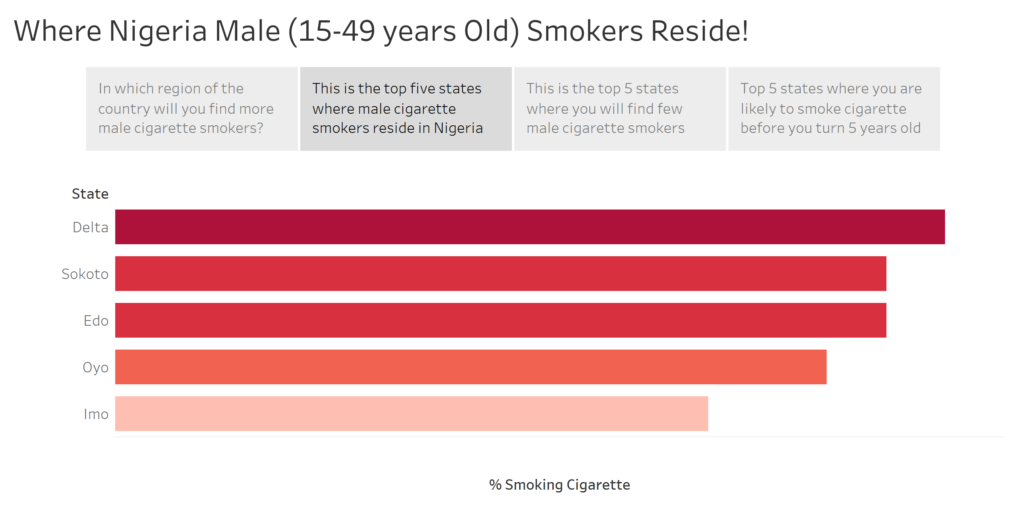
Only one out of every 100 men smoke a cigarette in Nigeria, while the number for the female smokers is so insignificant according to the Nigeria 2017 Multiple Indicator Cluster Survey. Nevertheless, Delta state is where you are likely to find most male smokers. As they say “Warri no dey carry last! Sokoto, Edo, Oyo and Imo state trail Delta state in that order.

In Cross River state, you are likely to see more teen smokers than any state in Nigeria. So, if you are planning to work on Tobacco use and abuse, Cross River and Delta State might be a good state to start your campaign.

If you are wondering where your state of residence falls on the list, you can visualize and download all dataset by CLICKING HERE

Living in Washington DC: 5 Interesting Things about the National Endowment for Democracy (NED) Reagan – Fascell Fellowship

In recent times, I have been asked about my experience as a fellow at the National Endowment for Democracy. In this piece, I would like to share five things that I found exciting about living in DC and the Fellowship. Yes, because you cannot take out the DC life from the fellowship, and I hope prospective and new NED fellows will benefit from these highlights. Caveat: This was my personal experience between during the winter of 2017 as a Reagan – Fascell Democracy Fellow, and I urge you to read until point 5, as I saved the best for the last. Happy reading.

1. Exploring living with a host was my best decision. While preparing for my move to DC, I was given the options of renting an apartment or living with a host. I took the latter and did not regret that. In terms of rent, I was paying a thousand dollar bucks a month at my host apartment in Woodley Park. I had access to a bathroom, a kitchen and a room, no I think room(s). My host introduced me to other networks and families in the DC area, which to me, was the most important part of my fellowship – nothing else. Giving out cookies for treats on Halloween, and making pies and turkey for the family on Thanksgiving was a super memoir. When my family came visiting DC, they were super helpful in advising on where to go for family events and family gatherings.

2. Planning for your project. “I wanted to write a handbook,” I told Sally during our initial meeting on my plan on my fellowship project. She responded that writing a book within your few months here might not be feasible but that nevertheless if I want to go ahead, I should draw up an action plan on how to achieve that within the next five months. Before leaving for DC, I already had an outline for the handbook, and I just had to work on drafting a plan and working with my research assistant to get the work done. Yes, I had a super cool research assistant, who helped in proofreading my excerpts and writing notes during meetings. I finished writing the manuscript of the book in the third month. Of course, there was 24 hours of power, access to a million + resources, and it was during the winter cold. No brainer, having an action plan did the work – Voila!

3. The upcoming policy events for the week. On Monday mornings, I always get a policy event in DC email from NED highlighting the list of policy events that will happen in DC during the week. Looking at those events, it reaffirmed to me that DC was the capital of the world. The policy events were organized for top policy discussions around continents in the world. As a fellow, you will also be privileged to hold a policy event at NED. My event was titled – Decaying Institutions: How Corruption Undermines Democracy in Nigeria. Want to know about what’s brewing in Africa, there is a dialogue or discussion about it. Think of any continent – there is always a policy event about that continent. I enjoyed attending a few of them at the Atlantic Council, Institute for the Analysis of Global Security, The OpenGovHub, The Brookings Institute, and The Carnegie Endowment for International Peace (CEIP). This gave me the opportunity to network with scholars and practitioners who were interested in my work, and to also explore possible ways of collaboration. Of course, I am currently consulting with one of the organizations I encountered during the policy events. Absolutely, your network is your net worth – no be lie!

4. Fellowship Brown bags and museums in DC. There was at least one brown bag every week. A Brown bag is an informal one hour knowledge sharing on a topic during lunchtime. Brown bags are organized for fellows or past fellows who are in DC, NED staff or the NED leadership. There are more than thirty museums in DC. During my fellowship, I was able to visit twelve. Top on my list was the National Museum of African American History and Culture, the Hirshhorn National Museum of Modern Art and the recently opened Museum of the Bible. Most of the museums in DC are free, so feel free to explore one every weekend. NED Fellows do visit other places of interest in DC, at least two places in a month. The visit to the Library of Congress remains the most memorable, aside from the visit to the African American History museum. Ask me why? I think The Library of Congress houses the history of America, and if you have a knowledgeable tour guide, he will give you an insight into the history of America within three hours.

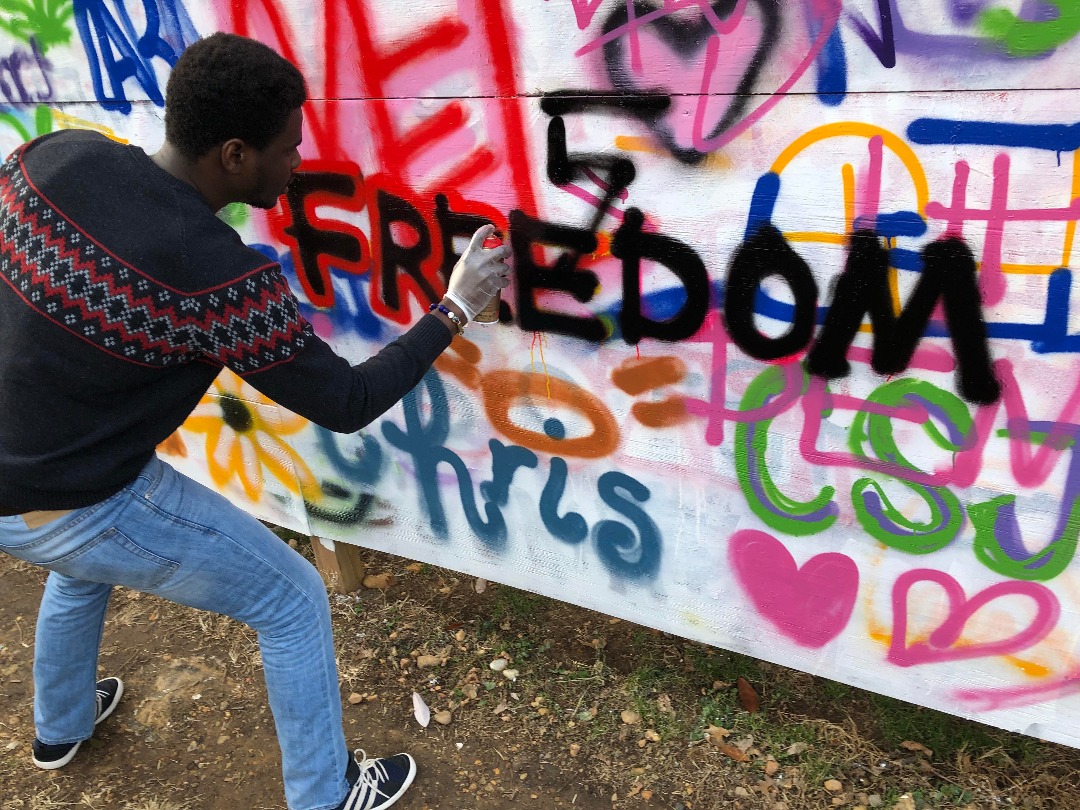
5. Some other important stuff. The fellowship activities were engaging but I still find time to involve myself in other “extra – fellowship activities”. For instance, I was at the Hip Hop Institute for three weekends to learn Hip Hop culture and Graffiti. There are other exciting stuff in DC you could learn as well during the fellowship. At Politics and Prose, you could hang out with book lovers to listen to book readings. Aha, one last thing, do not leave DC without hanging out at Busboys and Poets – it will leave your eyes, ears and tummies with such a unique experience. So what about the fellowship pay? To be frank, some were shy in asking this, but I think it’s very important as you will need it to pay bills and live the American dream – that’s if you have one. Total payment for the fellowship was US$28,500. Pay per month was 4,700 bucks but you always get around 4,017 bucks in your bank account at the end of the month owing to the tax deduction. When you arrive in DC for the fellowship, you will get a check by the end of the 2nd week of your arrival and your monthly payment at the end of that month. Happy Savings (Spend less!)

This was my fourth fellowship in five years, and I think this was the most useful because it allowed me to develop a product, interact with the American culture, network with people, reflect on my past work, and was a perfect segway for my launch to academics.

Four Registers, One Classroom: Why I Second-Guess Nigeria’s Official Numbers

Five years of chasing figures through Nigeria’s schools and clinics have taught me one rule: before you believe a number, find out who made it and what they will gain from it.

The head teacher reached for the admission register, a fat exercise book bound with masking tape, and ran her finger down the columns. Six hundred and twelve pupils, she said. That was the school’s own count.

At the Local Government Education Authority, the same school appeared with 780 pupils. At the State Universal Basic Education Board, it had 845. By the time the local government’s enrolment reached the planning figures that feed the national picture, it had grown by about a fifth in a year when the school’s own register was flat. On the morning I visited, I counted 431 children on the benches.

A few weeks later, at a primary health centre, it happened again. The outpatient register for one month showed about 290 attendances, each a name, an age and a complaint. The local government’s primary health care department reported more than 400 for that facility. The state’s figure was higher still. By the time the month reached the dashboards, it had gained nearly two hundred patients nobody could name.

The school and the clinic are composites, drawn from many I visited as an evaluator between 2013 and 2018. The figures are illustrative. The pattern is not. I have watched it repeat across states, sectors and years: one school or one clinic, and a different number at every level of government that touches it.

That is why, in 2018, I second-guess almost every headline administrative figure Nigeria produces, including enrolment, outpatient attendance, immunisation coverage, birth and death rates, and the census on which all of them rest. My reason is not that Nigerians cannot count. It is that at almost every level of our government, someone is rewarded for counting a particular way. The history of our censuses, the incentives written into how we share money, and the evidence of what happens when someone finally checks all point the same way.

Counting has always been political

In Nigeria, a headcount has never been just a headcount. Since before independence, population has decided seats in parliament and shares of national revenue. Every region therefore had a reason to want to be larger. Demographers trace the politicisation of census figures by ethnic interests back to the first post-independence counts. The 1962 exercise was abandoned amid disputes, and the 1973 results were cancelled outright.

The 2006 census was meant to break that pattern. It didn’t. The provisional results named Kano the most populous state, with 9.4 million, followed by Lagos with 9.0 million. Lagos had run a parallel count, and Governor Bola Tinubu said it found more than 17.5 million people, almost double. President Obasanjo dismissed the critics as “confusionists”.

Seven years later, in 2013, the National Census Tribunal nullified the 2006 results in 14 local government areas of Lagos and ordered a recount. In 2014 Festus Odimegwu, who had chaired the National Population Commission, went further. He said no census in Nigeria’s history had been valid.

It would be easy to turn this into a Lagos-versus-Kano quarrel, but that misses the point. Independent analysts reviewing the evidence have doubted both figures. The real lesson is that when a number decides money and power, every party to it has a motive and none of them has the standing to settle it. When the man who led the counting body says the count cannot be trusted, the rest of us are entitled to our doubts.

Those doubts have only grown with time. A new census was due in 2016, ten years after the last. In December 2015 the Commission said a 2016 census was not feasible. As I write in 2018, every official population figure in Nigeria, from the national total down to a ward’s catchment population, is a projection from a disputed 2006 count. Every enrolment rate, immunisation coverage rate, birth rate and death rate divides by one of those projections. If the denominator is a guess, so is the rate.

Every number has a constituency

The census is only the most visible case. The same logic runs through the everyday administrative data that schools, clinics and local governments produce, because Nigeria has written headcounts into how it shares money.

Start with the Federation Account. Under the horizontal formula, states share their portion on equality (40 per cent), population (30 per cent), internal revenue effort, landmass and terrain, and small weights for education, health and water. Local governments share theirs on a similar basis. Within their social development factor, primary school enrolment and hospital beds are counted. So a local government earns more if it reports more people, more pupils and more beds. I do not say any official sets out to cheat. I say the formula pays for the number, not for the truth of the number.

Now follow a single figure up the chain, as I have done many times.

  • The school or clinic. A head teacher knows that teacher postings, furniture, textbooks and attention follow enrolment. An officer in charge knows that drugs, commodities and staff follow attendance and catchment population. A modest rounding-up feels like protecting the children or the patients.
  • The local government. The LGEA or the PHC department collates dozens of returns, chases the ones that are late, and fills gaps with last term’s figure or an estimate. It also answers to the formula above.
  • The state. SUBEB and the state primary health care agency must reconcile local figures with last year’s totals, with targets in donor agreements, and with the counterpart funds they have committed. A sudden fall looks like failure, so the trend is smoothed.
  • The federal level. UBEC and NPHCDA receive aggregates, not registers. By the time a figure reaches Abuja, every adjustment beneath it has disappeared. The number arrives clean, and nobody can see where it came from.

This is what I mean by saying that aggregation launders a number. Each tier can be honest by its own lights, and the total can still be fiction.

None of this is peculiar to Nigeria, and the idea is not mine. The economist Charles Goodhart and the social scientist Donald Campbell both observed, in the 1970s, that a measure used to allocate rewards tends to stop measuring what it was meant to. James C. Scott, in Seeing Like a State (1998), described how governments need simple, legible numbers, and how people on the ground learn to supply them. And Morten Jerven’s Poor Numbers (2013) showed how fragile Africa’s development statistics are, with Nigeria as a central case. What is particular to Nigeria is how tightly money and power are tied to self-reported counts, and how many layers of government a figure passes through before anyone uses it.

When someone finally checks

Suspicion is cheap. What turns it into evidence is the moment someone checks a number against something that cannot be massaged: a satellite, a GPS trace, a fingerprint, a door-to-door count. In the last few years, Nigeria has had several such moments. Each one confirms the pattern.

Polio. For years, vaccination campaigns in the North were planned with inaccurate and incomplete hand-drawn maps, resulting in the exclusion of entire settlements. When outreach teams enumerated more than 46,000 scattered, nomadic and border settlements, 52 per cent of them were not in the microplan used for the previous campaign, and about one in five had been missed. In Kano, the state’s emergency operations centre found in August 2013 that target population estimates had been inflated. After a household-by-household recount, the number of identified settlements rose by 38 per cent, while enumerated households fell by 30 per cent. Monitoring reports put the cut in Kano’s under-five target population across all 44 LGAs at 53.4 per cent.

Read that again: more places, but fewer people. The old figures had overcounted children where vaccinators already went and left out the communities they never reached. This was the same distortion I saw in my classrooms, at the scale of a state. And it nearly cost the world polio eradication.

The payroll. In February 2016, after cross-checking civil servants’ records against their Bank Verification Numbers, the federal government removed 23,846 workers from its payroll who did not exist, a saving of about N2.29 billion a month. Every one of those ghosts had appeared in an official headcount of public employees. Nobody caught them until the payroll was checked against a biometric record that could not be invented.

Births and deaths. A birth rate or a death rate sounds like a fact. In Nigeria it is mostly an estimate. Only about 30 per cent of children under five have had their births registered, according to the 2013 Demographic and Health Survey. Even that figure is unsettled: another UNICEF profile reports registration rising from 23 per cent in 2007 to 60 per cent in 2013. From what I have seen in the field, death registration is thinner still. When most births and deaths never enter a register, the official rates come from surveys and models. They are useful, but they are not counts.

The economy. In April 2014, the National Bureau of Statistics rebased GDP, updating the base year from 1990 to 2010. The estimated size of the economy jumped from N42.4 trillion to N80.2 trillion, an 89 per cent increase. Overnight, Nigeria became Africa’s largest economy. The rebasing was a genuine improvement. But Jerven cautioned that the new figure still rests on a great many guesses. If the size of a whole economy can be understated by nearly half, the per-head figures built on it, and on a 2006 population count, deserve the same humility.

The best case against my doubt

There are serious people who would push back on this piece, and they deserve a hearing in their strongest form.

The first objection is that things are getting better, and that my examples prove it. The rebasing was the Bureau correcting itself. The polio programme built tracking systems and fixed its microplans. The finance ministry found its ghosts. The Statistician-General, Yemi Kale, has argued with Jerven himself that Africa may be seeing a statistical reawakening rather than a tragedy. On this view, a blanket scepticism punishes the reformers along with the fabricators.

The second objection is political. Doubt is not neutral. A government that dislikes its unemployment or poverty figures would like nothing better than a public that believes no number at all. A citizen who trusts nothing is easier to rule than one who trusts some things for good reasons.

The third is technical. Nigeria does not rely on administrative data alone. Household surveys such as the Demographic and Health Survey and the Multiple Indicator Cluster Survey exist precisely to check the registers. If you want the truth about enrolment or immunisation, the critic says, read the survey and stop worrying about the LGEA.

I accept much of this. The reformers are real, and I have worked alongside some of them. Cynicism is corrosive. Surveys are the best tool we have. But look at where every correction I have described came from. None of them came from the administrative chain checking itself. The ghost workers fell to bank biometrics. The phantom children fell to GPS trackers and door-to-door enumerators. The undercounted economy fell to a new base year. In each case, an independent instrument was needed to expose the official figure. That is my point, not a rebuttal of it.

Surveys, too, stand on the census. They draw their samples from enumeration areas mapped for the last count and weight their results to its projections. If the 2006 frame is wrong, the error travels quietly into the survey that is supposed to check it.So the doubt I am defending is not cynicism. A cynic says no number can be trusted and stops there. A sceptic asks what a number would have to survive before it deserves trust, and keeps asking. I trust a figure that has been checked against something its producer could not adjust. I second-guess a headline that has only travelled up the chain of the people paid by it.

How to read a Nigerian number

If doubt is a method, it needs rules. These are the ones I use, and I offer them to journalists, development partners, legislators and anyone who has to act on a figure from Abuja.

  1. Ask which tier produced it. A school register, an LGEA return and a national aggregate are three different claims. Find out which one you are looking at.
  2. Ask who gains if it rises or falls. If more pupils, patients or people bring more money, posts or seats, expect the figure to lean upward. If a fall would look like failure, expect it to be smoothed.
  3. Look for an independent check. A household survey, a GPS trace, a biometric audit or a headcount by someone with nothing at stake. A figure that has never met one is a claim, not a finding.
  4. Distrust smoothness. Real data are lumpy. Perfectly steady growth, rounded totals, or coverage above 100 per cent usually mean someone reconciled the number rather than measured it.
  5. Check the denominator. Every rate rests on a population figure, and every population figure in Nigeria today is projected from 2006. Ask how a rate would change if that base were wrong by a tenth.

Rules for readers are not enough, though. The system itself must stop paying for convenient numbers. Two reforms would go a long way.

First, publish the discrepancies instead of reconciling them away. If a school reports 612 pupils and the state reports 845, both figures should be public, side by side, with the gap explained. Sunlight on the gap would do more than another round of data-quality workshops.

Second, pay for verified numbers, not volume. Where money must follow headcounts, it should follow figures that have survived independent spot-checks: random headcounts in schools, register audits in clinics, verification by agents who are not paid by the people they verify. The polio programme and the payroll audit have already shown that this can be done in Nigeria. What is missing is the decision to apply it to the numbers that share our money.

Back to the classroom

I think often about the gap between 431 children on the benches and 845 on the state’s books. The missing four hundred did not need desks, textbooks or teachers, so the state planned for children who were not there. And if the same inflation runs everywhere, it also hides the children who are there but never counted: the nomadic settlement off the map, the infant whose birth was never registered, the patient seen at a clinic that never filed a return.

In this piece, I argued that Nigeria’s headline administrative numbers deserve doubt. That is not because counting is beyond us. It is because our history, our revenue formula and our layers of government reward particular numbers, and because aggregation erases the evidence of how they were made. Where independent checks have been applied, from polio maps to the payroll to the national accounts, the official figures have moved, sometimes by half.

The implication is uncomfortable but simple. A country that cannot count its children cannot plan their classrooms, vaccines or teachers. And a public that swallows every headline figure is not well informed. It has been misinformed with confidence.

This year Falz released “This Is Nigeria” (2018), a catalogue of the everyday absurdities Nigerians have learned to live with. Our numbers belong on that list. Until our figures are made, or at least checked, by people who gain nothing from making them larger, I will keep asking the same two questions of every headline – who counted, and what did they get for it?

Sources

Census history and the 2006 dispute

Revenue allocation

Polio microplanning and tracking

Payroll

Birth registration

GDP rebasing and data quality

Books and ideas cited without links

  • Morten Jerven, Poor Numbers: How We Are Misled by African Development Statistics and What to Do about It (2013)
  • James C. Scott, Seeing Like a State (1998)
  • Charles Goodhart (Goodhart’s law, 1975) and Donald T. Campbell (Campbell’s law, 1976)